


The Numbers
Terra Industries, a Nigerian defense technology startup building autonomous security systems, raised $22 million in an extension round led by Lux Capital just one month after closing an initial $11.75 million seed round. Total funding now stands at $34 million. The extension closed in under two weeks.
Existing investors 8VC (led by Palantir co-founder Joe Lonsdale), Nova Global, Silent Ventures, Belief Capital, Tofino Capital, and Resilience17 Capital (founded by Flutterwave CEO Olugbenga Agboola) participated alongside new angel investors Jordan Nel and actor Jared Leto. The company’s valuation now exceeds $100 million, up from approximately $42 million pre-money at the initial seed close.
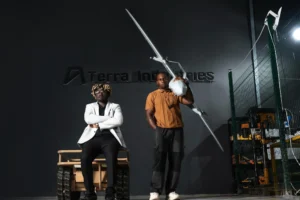
Founded in 2024 by Nathan Nwachuku (22) and Maxwell Maduka (24), Terra Industries designs and manufactures autonomous drones, sentry towers, unmanned ground vehicles, and maritime surveillance systems connected through ArtemisOS, its proprietary software platform for real-time threat detection and coordinated response. The company operates a 15,000-square-foot manufacturing facility in Abuja, staffed primarily by African engineers, with 40% of engineering staff having served in the Nigerian military.
Terra claims it currently secures infrastructure assets valued at approximately $11 billion across multiple African countries, including the Geometric Power Plant in Aba, two hydropower plants in northern Nigeria, and gold and lithium mining operations in Nigeria and Ghana. The company reports generating over $2.5 million in commercial revenue and has contracts worth “tens of millions of dollars” across public and private sector clients.
The new capital will fund expanded manufacturing capacity (currently producing “low hundreds” of devices annually, targeting thousands in 2026 and “tens of thousands” by 2027), accelerated deployments across Nigeria and other African markets, a second manufacturing facility in an undisclosed African country, a joint manufacturing facility in Saudi Arabia through partnership with AIC Steel, and growth of engineering and business development teams across Africa, London, and San Francisco.
Previous investors include Valor Equity Partners, SV Angel, Leblon Capital, Kaleo Ventures, and DFS Lab. The company previously raised an $800,000 pre-seed round.
Comparison
The global defense tech landscape provides sobering context. Anduril, the U.S. defense technology company founded by Palmer Luckey in 2017, has raised over $2.5 billion and reached a $14 billion valuation after nearly eight years. ShieldAI has raised approximately $1 billion since 2015. Saronic, focused on unmanned maritime systems, has raised around $830 million since 2022. These companies operate in the United States with direct access to Pentagon budgets exceeding $800 billion annually, established defense procurement processes, and a deep pool of aerospace engineers.
Terra Industries, by comparison, has raised $34 million in under a year, operates primarily in Nigeria (defense budget: ~$3 billion annually), and was founded by two mid-20s entrepreneurs with no prior defense company experience. Nathan Nwachuku’s background is in edtech (built an education platform before age 18), while Maxwell Maduka served as a UAV engineer in the Nigerian Navy before founding a drone company at 19.
African defense and security markets present unique dynamics. Most African governments rely on imported security infrastructure from Russia, China, or Western defense contractors. Russia supplies approximately 40% of Africa’s military equipment, China another 20%, with France, the US, and others accounting for the remainder. These relationships often come bundled with geopolitical strings, maintenance dependencies, and data sovereignty concerns.
The market Terra addresses is real. Africa accounts for 59% of global terrorism-related deaths (up from 1% seventeen years ago, according to Nwachuku). The Sahel region alone faces multiple insurgencies including Boko Haram (Nigeria/Chad/Niger/Cameroon), Al-Shabaab (Somalia/Kenya), and various IS/AQ affiliates. Nigerian security challenges specifically include kidnappings (over 4,000 abductions in 2024), pipeline sabotage (cost Nigeria $4B+ annually in lost oil revenue), and illegal mining (estimated $1B+ annually in stolen resources).
Infrastructure operators face acute threats. In Nigeria alone: Geometric Power Plant (client) faced multiple attack attempts before Terra deployment; multiple hydropower facilities shut down operations 2022-2024 due to security risks; gold and lithium mining operations regularly experience armed robberies and illegal mining incursions. Ghana’s mining sector loses an estimated $500M+ annually to illegal mining operations.
Comparable African defense/security startups are virtually nonexistent. No other African company has raised significant venture capital to build defense technology. Most security solutions come through government-to-government military aid programs or commercial contracts with established global primes (Northrop Grumman, Thales, BAE Systems, China’s NORINCO). Terra is creating a category.
The closest African tech comparison might be Zipline (Rwanda drone delivery, $500M+ raised) or Swvl (Egypt mass transit, shut down 2023 after burning $200M+). Both discovered that African market realities—infrastructure gaps, regulatory complexity, currency volatility, limited exit options—make capital-intensive hardware businesses extraordinarily difficult.
Business Model Reality
Defense technology companies face brutal unit economics. Anduril spent $500M+ before reaching $500M revenue (1:1 ratio). Most defense startups burn $50-100M reaching product-market fit because:
- R&D costs: $5-10M to develop each product category (drones, ground vehicles, towers)
- Manufacturing setup: $10-20M for production facilities, tooling, supply chains
- Sales cycles: 12-36 months for government contracts, 6-18 months for commercial
- Certification costs: Millions proving systems meet military/safety standards
- Customer acquisition: Government sales require relationships, lobbying, demonstrations
Terra’s claimed $2.5M revenue after ~2 years with $34M raised suggests they’re burning $15-20M annually and not yet profitable. For context:
- $34M raised
- ~$2M from pre-seed and seed expenses (legal, fundraising)
- ~$32M in company bank account
- Burn rate of $15-20M/year = 18-24 months runway before needing Series A
The “$11 billion in assets protected” claim requires scrutiny. If Terra protects Geometric Power Plant (valued at ~$100M), two hydropower plants (~$300-500M each), and several gold/lithium mines (~$100-500M each), that’s $1-2B in actual asset value. To reach $11B, either Terra is counting total project value including future buildouts, or they’re protecting many more sites than publicly disclosed.
The “tens of millions in contract value” also needs context. Defense contracts are typically structured as:
- Upfront hardware sale: $500K-$2M per site
- Annual service/data fees: $100K-500K per site
- Multi-year contracts: 3-5 years typical
If Terra has 10-20 sites protected with $1M average hardware + $300K annual service = $1-2M per site over 5 years = $10-40M total contract value. This is plausible.
The business model appears to be: Sell hardware systems upfront (drones, towers, ground vehicles) at $500K-$2M per deployment, then charge annual recurring revenue for ArtemisOS software (data processing, threat detection, system updates) at $100-500K per site. This creates a razor-and-blade model where hardware sales fund growth and software generates recurring revenue.
The valuation question: $100M+ valuation on $2.5M revenue = 40x revenue multiple. For comparison:
- Palantir (profitable, $2.5B revenue): trades at 40-50x revenue
- Anduril ($500M revenue, not public): valued at $14B = 28x revenue
- Defense contractors (Lockheed, Raytheon): trade at 0.8-1.2x revenue
Terra’s 40x multiple only makes sense if investors believe:
- Revenue scales rapidly (10x in 24 months possible given pipeline)
- Software margins emerge (70-80% gross margins on ARR vs 30-40% on hardware)
- Exit multiples stay high (strategic acquisition at 20-30x revenue or defense tech IPO boom continues)
If revenue reaches $25-50M in 24-30 months (plausible given claimed contract pipeline), a $100M valuation becomes 2-4x revenue (reasonable for high-growth defense tech). But if revenue stalls at $5-10M, the valuation is 10-20x revenue (expensive unless proving unique moat).
Risk
1. Founder Age & Experience Risk: A 22-year-old and 24-year-old running a defense technology company is unprecedented in modern business history. Palmer Luckey was 25 when he founded Anduril after selling Oculus to Facebook for $2B. Elon Musk was 31 when founding SpaceX. Defense requires navigating: multi-year government procurement processes, military-grade quality standards, geopolitical relationships, complex export controls, and life-or-death operational requirements.
Nwachuku’s background is edtech, not defense or hardware. Building a large-scale education platform is impressive at 18, but utterly different from manufacturing autonomous weapons systems. One mistake—a drone malfunction kills civilians, a security breach exposes government data, a system failure lets terrorists through—could end the company and create personal legal liability.
The 40% military engineering team helps, but military engineers follow orders and operate within established systems. Building a company requires: fundraising, financial management, product strategy, sales, manufacturing operations, supply chain management, regulatory compliance, HR, and strategic vision. Can two mid-20s founders without prior business scaling experience actually execute?
The speed of fundraising ($34M in weeks, closed in under 2 weeks) suggests investors are betting on the founders’ exceptional intelligence and ambition. But youth correlates with high failure rates. If Terra faces a crisis—product failure, government investigation, competitor aggression, capital constraints—do these founders have the experience and network to navigate it?
2. Nigerian Government Dependency: Terra’s largest contracts appear to be government or government-adjacent (power plants, government security). Nigerian government procurement is notoriously slow, corrupt, and political. Typical problems:
- Payments delayed 6-12 months (kills cash flow)
- Contracts cancelled when governments change (Nigeria has elections every 4 years)
- Procurement requires political connections (which can evaporate overnight)
- Corruption demands either participation (legal risk) or exclusion (business risk)
If 50%+ of Terra’s revenue depends on Nigerian government entities paying on time, the company faces permanent cash flow stress. Defense contractors globally solve this through: working capital facilities (banks lend against government contracts), diversification (many customers), or being large enough to wait. Terra has none of these. A single $5M contract delayed 12 months could force emergency fundraising or layoffs.
3. The “Vaporware Until Proven” Problem: Terra claims to protect $11B in assets with devices manufactured in a 15,000 sq ft facility producing “low hundreds” of units. Defense technology undergoes extensive field testing before deployment. Has Terra’s technology actually: detected real threats? Prevented actual attacks? Operated 24/7 for 12+ months without failure? Been tested against sophisticated adversaries (not just opportunistic criminals)? Received independent verification?
Most defense startups spend 3-5 years in development and testing before claims of protecting specific assets. Terra was founded in 2024 and is claiming operational deployments in 2026. Either they: (a) developed working systems extraordinarily fast, (b) deployed minimally viable products that haven’t been truly tested, or (c) are overstating deployment scope.
The risk: If Terra’s systems are deployed but not genuinely reliable, the first major failure (attack succeeds despite Terra system, false alarms cause operational disruption, system malfunction causes civilian casualties) destroys credibility. Defense customers—especially governments—have zero tolerance for failures on critical infrastructure.
4. The China/Russia Competition Problem: If Terra succeeds in becoming Africa’s defense prime, China and Russia will respond aggressively. These countries:
- Provide defense equipment at subsidized rates (often via concessional loans)
- Bundle defense sales with broader economic/political relationships
- Have decades of relationships with African militaries and intelligence services
- Can offer equipment and training packages Terra cannot match
When Turkey developed indigenous drones (Bayraktar) and began exporting to Africa, Russia responded by flooding markets with cheaper alternatives and leveraging political pressure. If Terra threatens Chinese or Russian defense market share in Nigeria (let alone other African countries), expect: competitive pressure (cheaper/better systems), political pressure (lobbying Nigerian government against Terra), operational sabotage (cyberattacks, supply chain disruption), and acquisition attempts (buy Terra to eliminate threat).
A startup with $34M cannot compete with nation-states spending billions to maintain African defense relationships. Terra needs to find niches (autonomous systems for critical infrastructure) where Chinese/Russian offerings fall short and move fast enough that competition can’t react. But defense markets move slowly, and Terra’s fundraising announcements have now alerted all competitors.
5. The “Series A or Death” Problem: Terra is burning $15-20M annually (educated guess based on $34M raised, manufacturing facility, 40+ employees, offices in multiple cities). With $30M in the bank after expenses, they have 18-24 months before needing Series A. This means by mid-2027, Terra must:
- Demonstrate $10-20M revenue run rate (4-8x growth)
- Show multiple large government contracts signed and delivering
- Prove systems work reliably at scale
- Expand to 2-3 African countries beyond Nigeria
- Build manufacturing capacity to 1000+ units annually
Failing any of these means Series A at flat/down valuation or inability to raise. Defense tech investors in 2027 will be much more skeptical than 2026. The hype cycle around African defense tech hasn’t even started yet, and Terra is first. If they stumble, investor appetite disappears.
Moreover, defense tech exits are extremely limited. Anduril remains private at $14B after 8 years. Palantir took 17 years to IPO. Most defense startups get acquired by large primes (Lockheed, Raytheon, BAE) at modest multiples. If Terra’s 2026-2027 growth disappoints, Series A becomes difficult, and the $100M valuation becomes an anchor preventing acquisition (no one acquires at 20-40x revenue unless absolutely necessary).
Prediction
By August 2026 (6 months): If Terra announces new commercial contracts totaling $5M+ ARR, momentum is real. If announces first international deployment (Ghana, Kenya, or Sahel country), expansion on track. If shows evidence of manufacturing scale-up (photos/videos of mass production, announced 1000+ unit orders), operational execution working. If quiet on revenue, contracts, or deployments, trouble.
Watch for: First public evidence of systems in operational use (news reports of foiled attacks, customer testimonials, independent verification) Would validate Terra’s claims. If only company press releases and founder interviews, healthy skepticism warranted. African government contract announcements. If multiple West African or Sahel governments announce partnerships, validates regional demand. If only Nigerian clients, market may be smaller than pitched.
By February 2027 (12 months): Success = $10M+ ARR, 5+ major contracts announced, systems deployed across 3-4 African countries, manufacturing producing 1,000+ units annually, Series A fundraising announced ($75-150M at $300-500M valuation), zero major system failures or security incidents. Partial = $5-8M ARR, 3-4 contracts, deployed in Nigeria + 1 other country, production 500-800 units, extending runway via debt or small equity raise, 1-2 minor incidents managed well. Failure = <$5M ARR, losing money on contracts (negative gross margins), unable to scale manufacturing, stuck in Nigeria only, cannot raise Series A, searching for acquirer or down round.
By February 2028 (24 months, Series A maturity): Success = $25-40M ARR, 70%+ gross margins on software, operations across 6-8 African countries, 5,000+ devices deployed, Series A closed at $400-600M valuation, clear path to $100M+ revenue and profitability. Partial = $15-25M ARR, 50-60% margins, 4-5 countries, 2,000-3,000 devices, Series A at $200-300M (flat/modest up), still burning cash but path to breakeven visible. Failure = <$15M ARR, unable to achieve software margins (stuck selling low-margin hardware), scaled back to Nigeria + 1-2 countries, burned through Series A capital, facing down round or shutdown.
By 2029 (3 years): Success = $75-100M+ revenue, profitable or near-profitable, operating across 10+ African countries, 10,000+ devices, Series B at $800M-1B+ valuation or acquisition by major defense prime at significant premium, established as Africa’s defense tech leader. Partial = $40-60M revenue, breakeven, 6-8 countries, 5,000 devices, difficult fundraising environment but surviving, valuation $300-500M. Failure = sold for $50-150M (below peak valuation) to strategic buyer, pivoted to pure software/services, or shut down after burning through capital.
Critical Determinants:
- Contract conversion: Moving from “tens of millions in pipeline” to signed, revenue-generating contracts. Defense sales are notorious for 80% of deals falling through.
- System reliability: Zero tolerance for failures in defense. First major incident (attack succeeds, civilian casualty, data breach) could be fatal to business.
- Government payment reliability: If Nigerian government pays slowly or defaults, burns cash waiting. Need either diversified commercial customers or credit facilities.
- Manufacturing execution: Scaling from “low hundreds” to “tens of thousands” of units requires supply chain mastery, quality control, working capital management. Hardware is hard.
- Founder maturity: Can two mid-20s founders navigate crises, manage 100+ person organization, handle geopolitical pressure, and execute 5-year vision? Age isn’t everything, but it’s something.
- Competitive response: How do Chinese/Russian/Western defense contractors respond? If they view Terra as threat, expect aggressive competition.
Honest Assessment:
Terra Industries has achieved something genuinely remarkable: raising $34M for African defense technology from top-tier investors (8VC, Lux Capital) in under two months with a 22-year-old and 24-year-old founding team. This is unprecedented.
The market problem is real. Africa loses billions annually to terrorism, infrastructure sabotage, and insecurity. Existing solutions are either ineffective (traditional security), expensive (Western defense contractors), or geopolitically problematic (Russian/Chinese systems). A homegrown African defense prime that delivers affordable, effective, sovereign security technology could genuinely transform the continent’s trajectory.
The technology appears legitimate. 40% military engineering team, operational deployments at real sites, and $2.5M commercial revenue suggest actual working products, not just PowerPoint presentations. The multi-domain approach (air, land, maritime) and software platform (ArtemisOS) indicate sophisticated thinking about integrated defense solutions.
The investor quality is exceptional. 8VC (Palantir connections), Lux Capital (deep defense tech experience), and strategic investors like Flutterwave CEO Agboola suggest smart money sees genuine potential. These investors passed on hundreds of other opportunities to back Terra. They’ve done deep diligence. They believe.
But the red flags are significant. Two years from founding to $11B in assets protected is extraordinarily fast for defense technology. Claims must be verified independently. The $100M+ valuation on $2.5M revenue is rich even by defense tech standards unless near-term revenue growth is explosive. The 18-24 month runway before Series A creates execution pressure. One stumble—delayed contract, system failure, geopolitical crisis—and the fundraising environment shifts dramatically.
The founder age is both Terra’s greatest strength and its biggest risk. A 22-year-old and 24-year-old bring: fresh thinking unburdened by “how things are done,” hunger and energy to work 100-hour weeks, willingness to take risks older founders wouldn’t, and credibility with other young African tech talent. But they lack: crisis management experience, network of government/military relationships built over decades, financial sophistication to manage complex defense contracts, and operational experience scaling organizations beyond 50-100 people.
The most likely outcome: Terra is genuinely building working defense technology and will achieve $15-30M revenue by 2028, proving the concept. But they’ll face execution challenges (manufacturing delays, contract slippage, government payment issues) that force a strategic sale to a larger defense contractor at $200-400M (2-4x current valuation), not the $1B+ exit that early investors dream about. Founders will be disappointed but still young (26 and 28), wealthy ($10-30M each from exit), and positioned to build their next company with more experience.
The bull case: Terra successfully scales to $100M+ revenue by 2029, becomes genuinely profitable through software margins, expands across 15+ African countries, and either: (a) IPOs at $2-3B valuation like Palantir, or (b) gets acquired by Microsoft/Palantir/Lockheed at $1.5-2B as their Africa strategy. Founders become the youngest self-made billionaires in African tech history.
The bear case: Terra burns through $34M in 24 months, achieves only $5-8M revenue (half the contracts fall through, government payments delayed, manufacturing bottlenecks), cannot raise Series A at acceptable terms, sells at $50-80M to Chinese defense contractor or Nigerian conglomerate. Investors lose 50% of capital. Founders walk with $5-10M each but are scarred by near-death experience.
Bet on the founders, not the financials. If Nwachuku and Maduka are truly exceptional—and the evidence suggests they might be—they’ll figure out how to navigate the obstacles. Defense technology is brutally difficult, but Africa desperately needs this solution. The market is real, the problem is urgent, and the timing is right. Whether Terra specifically becomes the winner remains to be seen, but African defense technology as a category has just been born.
Watch the next 12 months intensely. By February 2027, we’ll know if Terra is Africa’s next unicorn or a cautionary tale about overhyped hardware companies.