
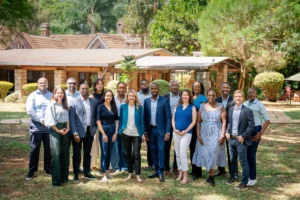
Delta40, a Kenya-based venture studio, raised $20 million to finance early-stage startups across Africa. The fund drew participation from 54 investors across 13 countries, with the Soros Economic Development Fund and Rockefeller Foundation serving as anchor investors. More than half the capital is commercial, return-oriented funding, with the remainder coming from development finance institutions and grant capital.
The investor base includes 14 Africa-based backers and 25 startup founders. Delta40 typically writes initial checks between $100,000 and $500,000 at the idea-to-seed stage and maintains capacity for follow-on investments.
Founded in 2021, Delta40 has invested in 16 companies over four years, including logistics platform Lori and solar fintech SunFi. The firm operates venture studios in Kenya and Nigeria, providing MVP development, team formation, and operational support. Focus areas include energy and mobility, agriculture and food systems, and financial services.
Comparison
Traditional African VCs like Partech, TLcom, and Novastar write checks to founders with existing ideas, provide board seats and network access, then remain largely hands-off except for quarterly meetings. Portfolio sizes typically run 20-40 companies per fund, with 10-20% ownership stakes. Success rates hover around 20-30%, with 70-80% of portfolio companies failing or becoming zombies.
This model struggles in Africa because first-time founders often lack operational playbooks for hiring, product development, and burn management. VCs lack bandwidth to provide hands-on support to 30 portfolio companies. The result: founders burn through $500,000 in 12 months with no traction, can’t raise Series A, and shut down.
Venture studios operate differently. They either generate startup ideas internally or validate founder concepts, then provide MVP development, co-founder matching, initial teams, product-market fit frameworks, and go-to-market strategies. Studios take larger ownership stakes—typically 20-40%—because they’re co-building rather than just funding. Companies “graduate” when they have product, traction, and team.
Global examples include Rocket Internet (Germany), which built 100+ companies including Jumia; Idealab (US), which has created 150+ companies since 1996 with 45+ IPOs and acquisitions; and eFounders (Europe), which has launched 200+ SaaS companies worth over $1 billion combined.
The African venture studio landscape remains small. Founders Factory Africa operates in South Africa and Kenya with 40+ companies built. Greenhouse Capital in Lagos built Shuttlers and Eden Life. Verod-Kepple Africa Ventures runs a studio-VC hybrid focused on fintech and logistics.
Delta40’s structure differs in three ways. First, it blends equity, debt, and grant capital—most studios use pure equity. This matters for African sectors like solar and agriculture that need working capital more than growth capital. Second, DFI and foundation backing from Soros and Rockefeller means patient capital willing to accept 10-15% returns instead of the 25%+ that commercial funds demand. Third, having 25 startup founders as limited partners creates operational expertise and network effects but also increases LP management complexity.
Business Model Reality
Traditional VC fund math allocates a $20 million fund across 20 companies at $1 million each, targeting 3x returns ($60 million) requiring 1-2 companies to exit at $30-50 million each.
Venture studio math requires operating budgets for engineers, designers, and product managers who build companies. Estimate $2-3 million annually for studio operations over a five-year fund life equals $10-15 million for operations, leaving $5-10 million for actual company investments.
At $100,000-$500,000 per company, this funds 10-50 companies depending on check size. The realistic middle: 20-25 companies at $200-250,000 average deploys $5 million.
Studios invest similar capital to VCs but add operational support worth $200-300,000 per company, justifying 25-30% ownership versus 15% for traditional VCs. Delta40 owns more because they’re building, not just funding.
For a $20 million fund to return 3x requires $60 million in exits. If Delta40 owns 25% average, they need $240 million in total exits across 20-25 companies—$10-12 million average exit per company.
But African seed-stage exits average $5-15 million for small acquisitions or acquihires. Exceptional exits of $50-100 million occur 1-2 times yearly across the continent. No venture-scale idea-to-seed investors have achieved unicorn exits yet.
Delta40 needs 2-3 companies exiting at $50-100 million each plus 5-8 companies at $10-20 million to hit 3x returns. This becomes harder because studios typically exit early—selling 10-15% at Series A to reduce exposure while maintaining 10-15% for later exits rather than holding 25% through exit.
Adjusted math: if Delta40 sells down from 25% at formation to 15% at Series A, they need $400 million in total exits—nearly impossible for an early-stage African portfolio.
Running a venture studio requires substantial fixed costs: 5-10 engineers at $50,000-$80,000 each, 3-5 designers at $40,000-$60,000, 3-5 product managers at $60,000-$100,000, 5-8 operations staff at $30,000-$50,000, plus $200,000-$400,000 in overhead. Total annual studio costs run $900,000-$2.4 million, or $4.5-12 million over five years.
If $10 million goes to operations from a $20 million fund, only $10 million deploys into companies. At Delta40’s current pace of 4 companies yearly, they’ll build roughly 20 companies over five years, using $5 million for investments, $10 million for operations, and $5 million for follow-ons.
Risk
Venture studios work best building similar companies repeatedly. Idealab focused on internet and media businesses with similar tech stacks. eFounders built 200 B2B SaaS companies with repeatable playbooks. Rocket Internet literally cloned proven models.
Delta40 spans solar fintech (hardware plus financing plus distribution plus rural last-mile), logistics (marketplace plus fleet management plus driver networks), and agriculture. Each requires different expertise, go-to-market approaches, and unit economics. Studio teams can’t be experts in solar supply chains AND trucking logistics AND smallholder agriculture simultaneously. Risk: building mediocre MVPs across diverse sectors instead of excellent companies in one vertical.
The graduation timeline creates another problem. Western studios graduate companies in 6-12 months when they demonstrate product-market fit, hit $100,000-$500,000 ARR, and have full founding teams. In Africa, product-market fit takes 18-36 months due to slow customer adoption, weak payment infrastructure, and complex regulations. Reaching $100,000 ARR takes 2-3 years for B2B, 3-5 years for B2C. Finding full teams takes 12-24 months in talent-scarce markets.
If Delta40’s companies take 24-36 months to graduate instead of 6-12 months, the studio can only build 1-2 new companies yearly instead of 4. Resources lock up supporting older cohorts, investment pace slows, and the fund can’t deploy $20 million in five years.
Studios taking 25-40% ownership create founder conflicts. Founders feel like employees rather than owners when the studio holds majority stakes. When companies succeed, founders owning only 20-30% feel cheated. The best founders avoid studios and go straight to VCs who take 15-20%. Studios end up with second-tier founders who couldn’t raise traditional VC, explaining why success rates aren’t actually 2x better.
Blended capital mixing equity, debt, and grants sounds smart but creates accounting complexity. If a solar company receives $200,000 equity (for 25% ownership), $200,000 debt (to be repaid), and $100,000 grant (for pilots), that’s $500,000 invested, but $200,000 returns as debt repayment and $100,000 generates no return. From a fund perspective, only $300,000 stays deployed.
Debt only gets repaid if companies generate revenue. Many African startups are pre-revenue for 3-5 years. If startups fail, all $500,000 is lost, not just the equity portion. Grants are pure costs with no returns. Blended capital works if 60-70% of companies reach revenue stage and repay debt. If failures are slow—companies zombifying for 3-4 years—blended capital becomes a subsidy program rather than a venture fund.
Having 25 startup founders as LPs creates expectations they’ll help portfolio companies. But founders are busy running their own startups and can’t spend 5-10 hours weekly helping Delta40’s portfolio. If Delta40 returns 0.5x (loses half the fund), 25 founder relationships are damaged. Word spreads in the tight-knit African founder community, damaging future fundraising. A better LP structure: 10-15 institutional investors writing $1-2 million checks each with professional expectations.
Prediction
By August 2026 (six months), if Delta40 announces 3-4 new studio companies, they’re maintaining their 4-per-year pace. If 2-3 earlier companies raise Series A from external VCs, the graduation model is working. Watch whether graduated companies raise at $10 million-plus valuations—if yes, the studio is adding real value; if $3-5 million, they’re just incubating ideas anyone could have built.
By February 2027 (12 months), if 5+ companies have graduated with external funding, the production line functions. If 1-2 companies shut down or pivot, that’s acceptable failure rate. If 5+ companies remain in the studio after 24+ months, the graduation problem is confirmed. Track revenue: if 30%+ of portfolio companies hit $100,000+ ARR, business models are viable; if under 20%, they’re building companies that don’t generate revenue.
By February 2028 (24 months), success looks like 25-30 companies built, 15+ graduated, 8-10 raised Series A, 2-3 at $5 million+ ARR, one clear winner emerging, $5 million+ deployed into follow-ons, and studio operating efficiently at $1.5 million yearly. Partial success: 18-22 companies, 10 graduated, 5 raised Series A, 1-2 at $2 million+ ARR, $3 million in follow-ons, studio costs $2 million+ yearly. Failure: under 15 companies, under 8 graduated, under 3 raised external capital, none profitable, studio costs $2.5 million+ yearly eating investment capital.
By February 2029 (three years), success means 1-2 companies exit via acquisition or secondary for $20-50 million each, Delta40 returns $10-20 million to LPs (1-2x in first exits), 5+ companies at Series B/C stage, clear path to 3x fund return. Partial success: one small exit ($5-10 million), $2-5 million returned to LPs, 2-3 companies at Series B, path to 1.5-2x return possible. Failure: zero exits, companies trapped at Series A or stalled, some shut down, fund underwater, difficult to raise Fund II.
By February 2031 (fund maturity at five years), success delivers 3-5 exits totaling $150 million+, with Delta40 owning 15-20% average equals $22.5-30 million returned, plus 3-5 companies still in portfolio worth $50-100 million total ($7.5-20 million paper value), for total portfolio value of $30-50 million (1.5-2.5x fund return). Operational lessons are documented and Fund II raises at $40-50 million. Partial success: 2-3 small exits ($30-50 million total), 5-10% average ownership ($3-5 million returned), remaining portfolio worth $10-20 million, total $13-25 million (0.65-1.25x return), studio model worked for some companies but economics are tough, Fund II questionable. Failure: one or zero exits, under $10 million returned, portfolio mostly failed or zombies, 0.5x or less return, studio burned too much capital on operations, model doesn’t work at African early-stage scale, no Fund II.
Success determinants: Can Delta40 take companies from idea to $500,000 ARR in 18 months (Western studios do 12 months; African markets are slower)? If taking 30-36 months, the model breaks—too slow, too expensive. Do 50% of graduated companies raise $2 million+ Series A within 12 months of leaving the studio? If under 30%, they’re graduating companies that aren’t ready. Does Delta40 maintain 20%+ ownership through Series A, or are they forced to sell down to 10-12% because they can’t lead rounds? Can the studio operate on $1.5 million yearly or less (target: under 25% of total fund)? Does Delta40 double down on winners with $500,000-$1 million follow-ons, or spread capital evenly? Does Delta40 narrow to 1-2 sectors where they build real expertise, or keep building across energy, agriculture, and fintech with shallow knowledge?
The critical signal comes by February 2027. Watch how many companies have graduated AND raised external Series A. If 5+ companies, the model is working. If 2-3, they’re struggling. If 0-1, Delta40 is an incubator or accelerator program, not a company builder. If Delta40 can graduate 15+ companies over five years with 50%+ raising Series A and 20%+ reaching $2 million+ ARR, they’ve built something valuable. If under 10 companies graduate or under 30% raise Series A, the venture studio model doesn’t work at African seed stage—regular VC with operational support would have been simpler and cheaper.